
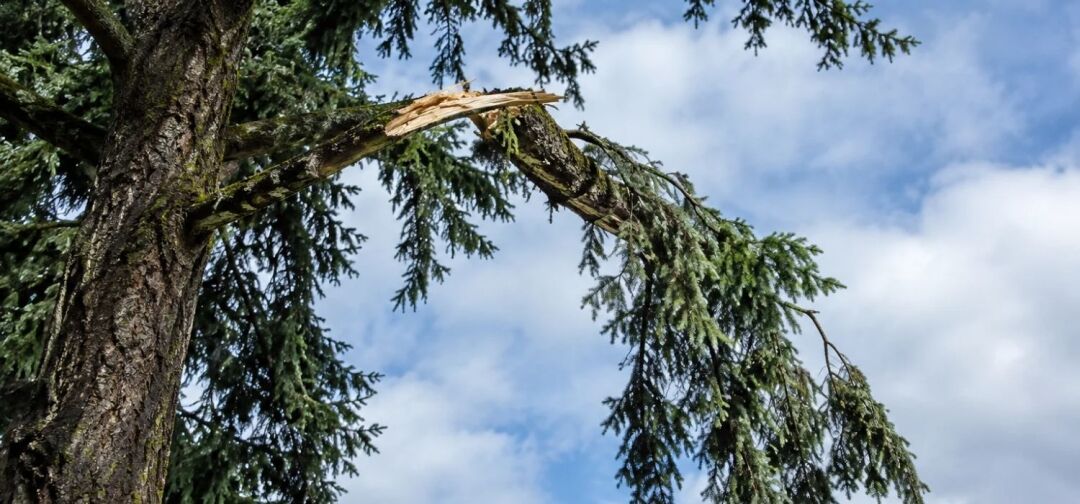
After a big blow comes through Lacey, WA, or the surrounding area, it’s worth taking a slow walk around your yard and looking up. Sometimes a storm leaves an obvious mess on your lawn. Other times, the real problem is still up in the tree: a snapped limb caught in the branches, or one dangling by a strip of bark over the driveway.
These are widow maker tree branches, and they earned that name honestly. Here’s how they form, how to spot them from the ground, what to do when you find one, and why hanging branch removal is one job to leave to a pro.
A widow maker is any large branch that’s broken or dead and could come down without warning. They usually show up in one of three ways:
What makes all three so dangerous is their unpredictability. A hanger can sit in place for weeks, then drop when a light breeze shifts the branches it’s resting on. A heavy limb falling from high in a tree doesn’t need much of a head start to do serious damage.
Most widow makers trace back to one of three things: storms, decay, or poor pruning cuts.
Weather causes a lot of them. Strong winds twist and load branches until something gives, and heavy, wet snow or ice piles on, adding extra weight. When a limb breaks, the canopy below often catches it. That’s how so many storm-damaged tree limbs end up hanging high in a tree instead of lying on the ground where you’d notice them.
A branch can look fine from a distance while rot works on it from the inside. Old breaks, bad cuts, and insect damage let decay fungi in, and eventually the branch gives out under its own weight or a moderate gust.
How a tree gets cut matters, too. Flush cuts against the trunk remove the branch collar the tree uses to seal wounds, while long stubs tend to die back and rot. Topping triggers a burst of weakly attached sprouts. Any of these mistakes can set up a future break.
You don’t need to climb anything to find the most dangerous tree branches. Grab binoculars, pick a bright day, and walk slowly around each big tree, looking up from a few different angles.
Here’s what to watch for:
Take photos of anything that looks off. Pictures help a pro size things up before they arrive, and they’re useful for insurance if a limb has already damaged something.
We get it. A broken limb is just sitting there, and you own a chainsaw. Here’s why that combination worries tree pros:
Small, light deadwood you can reach from the ground with a pole pruner is usually fine to handle yourself. Anything big, high, broken, or tangled calls for hazardous branch removal by a crew with the right gear.
A good crew starts by studying the hanger from the ground: how it’s caught, what’s holding it, and what sits underneath. That tells them the safest way in.
When access is good, our 55-foot bucket truck lets our crew work beside the limb without anyone having to climb the damaged tree. If the truck can’t reach it, we climb instead. Our crew lowers heavy pieces with ropes, so nothing drops onto your roof or lawn.
Storms rarely break just one branch, so it’s smart to have the crew check the rest of the canopy while they’re there. That’s also a good time for some tree trimming to clear deadwood and other weak spots before the next windstorm.
We price every job based on its own details. The biggest factors include the following:
A hanger over an empty corner of the yard can usually wait for a scheduled visit. Keep the area marked and book an estimate.
It’s a different story when a limb has already crashed onto your house. We answer our phone after dark for situations like that. Our crew can clear the limb and tarp or board up the damage so you’re not staring at an open roof all night. A branch down on the lawn can wait until morning.
We’re a licensed, insured, and bonded company and a member of the Tree Care Industry Association. Our owner has been in the tree business since he was 18, and he’ll give you an honest read on whether a limb needs to come down today or can wait a bit.
Estimates are free in our service area. We also offer financing and discounts for first responders, veterans, and seniors. If a broken limb is hanging over your yard in Lacey, WA, or nearby, reach out to Carlson Tree Care, and we’ll take a look before it comes down on its own.
Shelton WA 98584
Mon - Fri 8am- 6pm
Sat - Sun by Appointment
Call us for a free estimate
360-490-7001
