
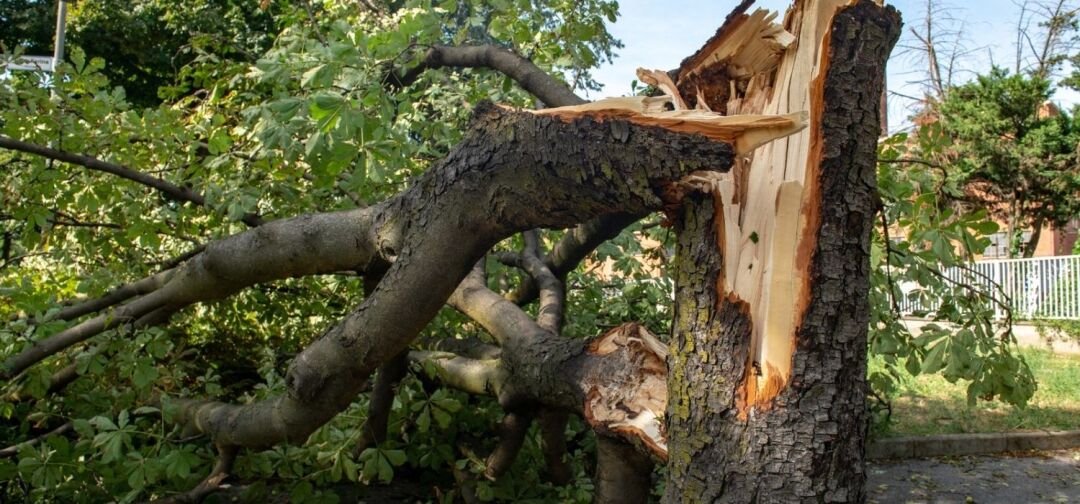
When the first big wind warning of the season hits, plenty of homeowners in Dayton, WA, and Sunnyslope, WA, end up staring out the window at that tall fir by the driveway. It’s a fair worry. Most trees ride out a storm just fine, but the ones with hidden weak spots tend to announce themselves at the worst possible time.
You can spot many of those weak spots yourself well before the wind picks up. This guide covers:
Think of it as windstorm tree prep from someone who spends a lot of time up in the canopy.
Every fall and winter, our trees deal with a rough combo: soaked ground and strong gusts arriving at the same time. Rain softens the soil around the root plate, and wind pushes hardest on the biggest, fullest canopies. Tall conifers keep their needles all year, so they catch a lot of wind even in midwinter.
A few things raise the risk on rural and wooded lots in Mason County, WA.
Newly exposed trees are one. Trees that grow up inside a stand rely on their neighbors for wind protection. When someone clears nearby trees for a home site or driveway, the trees left on the new edge suddenly take wind they’ve never had to handle. Edge trees are especially prone to blowing over in the first few years after clearing.
Disturbed roots cause trouble, too. Trenching for utilities, a new driveway, or changes to drainage can cut or drown roots. The tree may look fine for a few years before it starts to struggle.
Short-lived species round out the list. Red alder grows quickly and is found throughout Western Washington, but it’s relatively short-lived and prone to decay as it ages. A big old alder near the house deserves a closer look.
Pick a calm, dry afternoon and walk around each tree that could reach your house, driveway, shop, or anywhere people spend time. A pair of binoculars helps with the upper canopy. Stay on the ground for this part, since climbing a tree to inspect it is a good way to get hurt.
Here’s an easy trick for tracking lean. Stand in the same spot each fall and take a photo of the tree next to something straight, like a corner of the house or a fence post. Comparing photos year to year makes a new lean much easier to catch.
Jot down anything you find, with dates and photos. That record makes it easier to decide what needs attention first.
Tree pros don’t judge risk by the defect alone. They also look at what the tree would hit if it failed. A cracked limb over an empty pasture is a low priority. That same limb over a kid’s bedroom moves straight to the top of the list.
So when you’re sorting through your notes, ask two questions about each tree:
Trees with real defects that could hit your house, a driveway, a play area, or a power line come first. Everything else can usually wait for routine work.
Good storm tree trimming goes after the parts of a tree most likely to fail in the wind. Typical work includes the following:
On jobs with good access, our 55-foot bucket truck gets the crew up into the canopy without anyone having to climb. On wooded lots where a truck can’t fit, we climb.
Storm season tree trimming works best before the worst weather sets in, but better late than never. Hazard work, like deadwood over a bedroom or a cracked limb above the driveway, makes sense any time of year. Routine shaping on deciduous trees can wait for winter dormancy, when bare branches make each limb’s structure obvious.
Sometimes the safest fix is taking the tree down. Hazardous tree removal is usually the right call when a tree has:
Dead tree removal before winter deserves its own mention. Once a tree dies, its wood dries out, begins to decay, and becomes more brittle over time. The longer a dead tree stands, the riskier it is to climb and rig. Getting it down before the storms arrive is usually safer for everyone, including the crew.
Trees near houses often don’t have room to fall in one piece, so we take them apart in sections. In the tightest spots, we use a crane for a low-impact removal that keeps heavy pieces off your roof and lawn. Afterward, you can keep the wood as firewood or logs, have it chipped into mulch, or have us haul it off.
You may come across cabling and bracing, which use steel or synthetic cables or metal rods, to support weak branch unions. Some arborists install these systems, but Carlson Tree Care doesn’t offer them. If one of your trees might be a candidate, we’ll tell you so you can talk with a company that does that work.
A lot of tree storm damage prevention happens long before anyone picks up a saw. These habits help your trees handle wind better over time:
When the forecast calls for high winds:
Even with good prep, storms win sometimes. If a tree lands on your house in the middle of the night, we pick up the phone, even in the early morning hours. Our crew can get the tree off your home and tarp or board up the damage so your family can rest. That’s exactly what those middle-of-the-night calls are for. A limb lying in the yard can wait for daylight.
Carlson Tree Care is licensed, insured, and bonded. We’re also a member of the Tree Care Industry Association. We’ll tell you straight which trees look fine, which ones need trimming, and which ones are better off coming down.
We offer free estimates within our service area, financing, and a discount for first responders, veterans, and seniors. If you’ve got a tree that makes you nervous every time the wind kicks up, reach out to our crew before the next storm rolls through Mason County, WA.
Shelton WA 98584
Mon - Fri 8am- 6pm
Sat - Sun by Appointment
Call us for a free estimate
360-490-7001
