
Got a tree that’s leaning a little more than it used to? Branches scraping the roof every time the wind picks up? Around Olympia, WA, problems like these build slowly, then show up all at once during the first big storm of the season.
Most tree trouble gives you warning signs well before it becomes an emergency. This guide covers how to spot those signs, what common residential tree care services actually involve, which jobs you can handle yourself, and what to check before hiring anyone in Olympia, WA, or Lacey, WA.
Our winters keep the ground saturated for months. Wet soil grips roots far less firmly than dry soil, so a tall Douglas fir with a full canopy can tip over in a windstorm even when the tree itself is healthy. Foresters call this windthrow, and it’s one of the most common ways big conifers come down around here.
Summer brings the opposite problem. Long dry stretches stress trees, and stressed trees have fewer resources to fight off decay and insects.
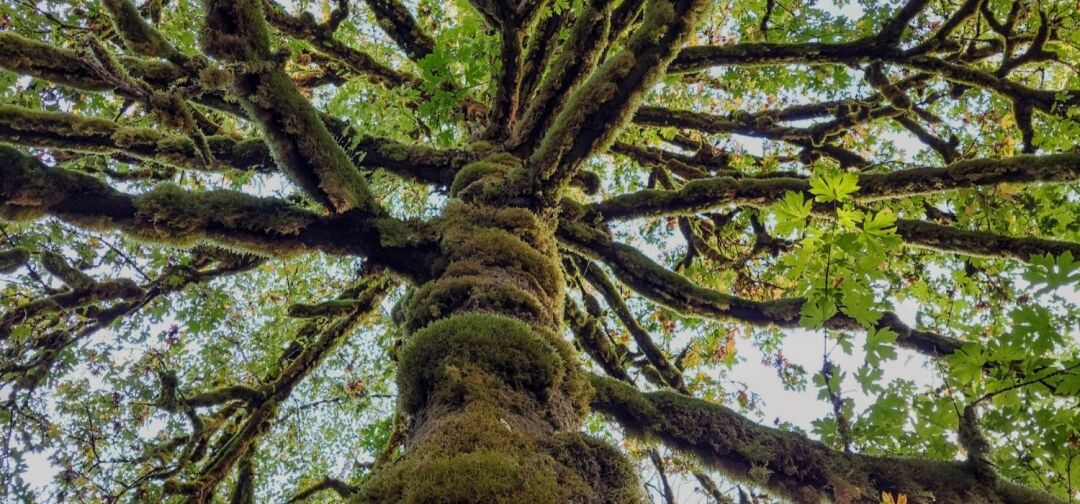
Bigleaf maples deserve a special mention. They often grow multiple trunks from a single base, and where those trunks meet, bark can become trapped in the joint. That creates a weak union that can split under the weight of a heavy, leafed-out canopy. If you’ve got a big multi-trunk maple near the house, have someone check where the stems join.
You don’t need any training to spot most red flags. Grab a coffee and walk around each tree near your house, driveway, or play areas. Look for these:
Spotting one of these doesn’t automatically mean the tree has to go. It does mean it’s time for a closer look from a good yard tree service.
Plenty of small jobs are fine to do yourself. Clipping small branches you can reach from the ground with hand pruners or a pole pruner is generally safe, as long as nothing’s near a power line. Picking up sticks and small limbs after a storm is no problem, either.
Call a pro for anything that involves:
Jobs that look simple from the ground are often the ones that go wrong.
Tree trimming is usually the first service a homeowner needs. People use the words “trimming” and “pruning” interchangeably. Trimming tends to focus on clearance and shape, while pruning focuses on health, such as removing dead, diseased, or rubbing branches.
On a South Sound property, the work usually includes:
How we reach the tree depends on your yard. Our 55-foot bucket truck works well when there’s solid access. When the truck can’t get close or the lawn’s too soggy to drive on, we climb the tree instead. Climbing lets us work in spots the truck can’t reach and keeps heavy equipment off your grass.
We’ll be honest about topping. We can do it if you ask, but we’ll usually try to talk you out of it. Topping cuts off the main leader and leaves big wounds. The tree responds with lots of fast, weakly attached sprouts, which often makes it more hazardous within a few years. A proper crown reduction or thinning usually gets you what you want without that problem.
For most deciduous trees, late winter into early spring is a good window for tree trimming. Trees are dormant, and you can see the branch structure clearly. Maples and birches may drip sap from fresh cuts this time of year. It looks alarming, but it doesn’t hurt the tree. Hazard work, like a cracked limb over your bedroom, shouldn’t wait for the right season.
You may need to remove a tree if it has major trunk decay, a recent lean, lifting roots, or dieback that keeps spreading down from the top. It may also need to go if it’s simply grown too close to the house.
Most residential yards don’t have room for a whole tree to fall, so removal happens in sections. A typical sectional removal starts with setting up a safe work zone, then taking the tree apart from the top down. Rigging lowers each heavy piece in a controlled way.
For tight spots, we use cranes for low-impact removals. The crane lifts sections up and away from your house, fence, garden beds, or septic field, so nothing lands where it shouldn’t.
Once the tree’s down, you decide what happens to the wood:
Several things affect what a removal costs:
That’s why two trees that look the same size can come with very different price tags.
Some cities regulate the removal of certain trees, especially large ones or trees near streams, wetlands, or steep slopes. Olympia, Lacey, and Thurston County each have their own rules, so check with your city before scheduling.
A leftover stump trips people, wrecks mower blades, and gives critters a home. When we remove a tree, we grind the stump down to ground level so you can use the space again.
Grinding leaves the roots in the ground to break down over several years. That’s fine for lawn or garden beds. If you’re building, regrading, or planting another tree in that exact spot, full extraction removes the stump and main roots so nothing gets in the way.
When a tree lands on your house at 2 a.m., we answer the phone. We’ll come out, get the tree off your home, and tarp or board up the damage so your family can get some sleep. We keep after-hours calls for real emergencies, like a tree on a house or car, or one blocking your only way out. A branch down in the backyard can wait until morning.
If a tree comes down at your place:
Once the urgent part’s done, our tree cleanup services clear fallen limbs, scattered branches, and brush piles. It’s also smart to have the remaining trees checked. Storms often leave cracked limbs or hangers high in the canopy that you can’t see from the ground.
Storm season brings out door-knockers offering quick, cheap tree work. Before you hire anyone in Olympia, WA, or Lacey, WA, check for the following:
Carlson Tree Care is licensed, insured, and bonded, and we’re a member of the Tree Care Industry Association.
Spending a good chunk of money on a tree isn’t anybody’s idea of fun. Dustin has been cutting trees since he was 18. He’ll explain what he sees, lay out your options, and let you decide without a hard sell.
Estimates are free within our service area. We also offer financing and a discount for first responders, veterans, and seniors.
So, got a leaning tree, a limb hanging over the roof, or a storm mess to deal with? Reach out to Carlson Tree Care, and we’ll come take a look.
Shelton WA 98584
Mon - Fri 8am- 6pm
Sat - Sun by Appointment
Call us for a free estimate
360-490-7001
