
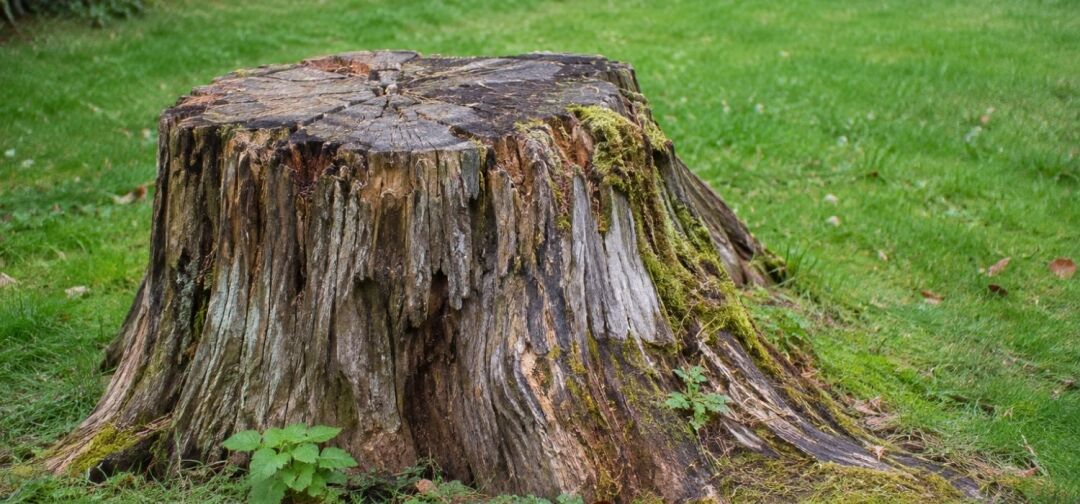
The tree’s gone, but that stump is still sitting there. Maybe you mow around it every week, or maybe it’s right where you want a new garden bed. Either way, you’ve got two main options for getting rid of it, and they’re more different from each other than most people expect.
If you’re comparing your stump grinding options in or around McCleary, WA, against pulling the whole thing out, this guide covers:
That old stump does more than take up space. It hides in tall grass and catches toes and mower blades. Some species send up new shoots from it for years. And as it rots, it can draw insects. Carpenter ants, which are common in the Pacific Northwest, love to nest in damp, decaying wood. That’s a stump you don’t want sitting right next to your house.
Both methods remove the visible stump, but they handle what’s underground in very different ways.
A stump grinder uses a spinning wheel lined with hardened teeth to chew the stump into small chips. The operator sweeps the wheel back and forth until the stump is gone. When we remove a tree, we often grind the stump down to ground level so you can use that part of your yard again.
Grinding leaves the root system in the ground, where it slowly breaks down over the years. You end up with a pile of grindings, a mix of wood chips and soil, right where the stump used to be.
Stump extraction removes the stump and its main roots entirely from the ground. That means digging around the stump, freeing the major roots, and lifting the whole mass out.
Extraction leaves a hole instead of a pile of chips, and the work disturbs more of the surrounding yard. In exchange, the main root system is gone, so nothing big stays underground to get in the way later.
Here’s a quick look at how the two stack up:
| Stump Grinding | Stump Extraction | |
| What’s Removed | The visible stump, down to ground level | The stump and main roots |
| Roots Left Behind | Yes, and they decay slowly | Major roots are gone |
| Yard Disruption | Fairly contained | Digging disturbs a larger area |
| What’s Left | A pile of grindings | A hole that needs filling |
| Best For | Lawns, beds, and spots you won’t build on | onstruction, regrading, or replanting in the same spot |
For most yards, grinding is the simpler, less disruptive choice. It’s a good fit when:
After grinding, many homeowners rake out most of the grindings, add some topsoil, and reseed. The spot may settle a little over time as buried wood and roots break down, so adding a bit more soil down the road is normal.
Sometimes grinding just isn’t enough. Full stump removal through extraction is usually the better choice when:
Before any digging, state law requires a utility locate through Washington 811. It’s free, and it keeps everyone clear of buried lines.
It depends on the tree. Most conifers, including Douglas fir, don’t resprout from a cut stump. Once you cut them, they’re done.
Many broadleaf trees are a different story. Bigleaf maple, cottonwood, willow, and younger red alder can push up new shoots from the stump or roots. Grinding knocks back a lot of that regrowth, but a few sprouts can still pop up. Clipping them as they appear usually wears the roots out over time. If they keep coming back, extraction may be worth a look.
After grinding, the remaining roots decay on their own. That can take years, depending on the species and the size of the tree. For lawns and garden beds, it’s usually not a problem.
There’s one exception worth knowing about. If the tree died from a root disease, leftover roots can sometimes carry it. Some root rots common in Western Washington can spread to nearby newly planted trees, and several mainly attack conifers. If you suspect disease, mention it before deciding what goes in that spot. A broadleaf tree is often a safer replacement than another conifer.
Every stump is a little different, so pricing depends on the details. The biggest factors include:
Still on the fence? Ask yourself the following questions:
If your answers point to lawn, plants, or “just get it out of the way,” grinding is probably your best bet. If they point to building, regrading, or replanting right there, ask about stump extraction.
McCleary sits in Grays Harbor County, and Carlson Tree Care serves it along with nearby communities in Mason and Thurston counties. We grind stumps down to ground level and offer full stump removal when your plans call for it.
Our crew is licensed, insured, and bonded, and the company is a member of the Tree Care Industry Association. Estimates are free in our service area. We also offer financing plus a discount for first responders, veterans, and seniors. If a stump’s been bugging you, reach out to our team, and we’ll help you figure out which approach fits your yard.
Shelton WA 98584
Mon - Fri 8am- 6pm
Sat - Sun by Appointment
Call us for a free estimate
360-490-7001
