
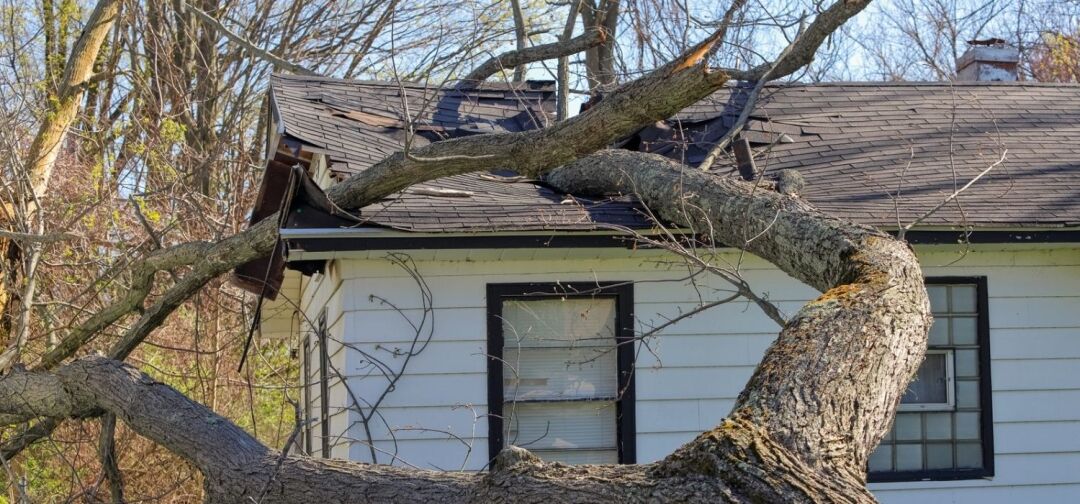
Picture it. The wind’s been howling since dinner, the lights just flickered, and then a crack and a thud shook your whole house. A tree just came down on your roof, and it’s 2 a.m.
We pick up calls like that. Our 24-hour tree service means a real person answers in the middle of the night. Then we drive over in the rain, get that tree off your house, and cover the damage so your family can get back to sleep. Below, you’ll find what to do in the first few minutes, what our crew does upon arrival, and how to lower the odds of a repeat in Shelton, WA.
If you just typed “tree fell on a house” into your phone at 2 a.m., start here. Everything feels urgent at once, so work through this list in order. People come first, and property comes second.
A tree falling over usually isn’t random. Western Washington stacks a few problems on top of each other, starting with the rain.
Weeks of fall and winter storms saturate the ground, and wet soil grips roots far less than dry soil does. A Douglas fir that has weathered summer winds can tip once the ground softens.
Root disease adds to the trouble. Laminated root rot and Armillaria root disease are common in Pacific Northwest conifers, especially Douglas fir. Both attack roots underground, so a tree can look green and full on top while its anchor fails below. When one of these trees falls, the root ball often looks small and snapped off, rather than coming up as a large plate of soil.
Then there are the newly exposed trees. Trees that grow up in a group shelter each other from the wind. When someone clears neighboring trees for a new house, or a storm knocks them down, the survivors suddenly have to deal with wind they never had to handle. One fallen tree is a good reason to check the ones around it.
Timing matters too. Our windiest stretch usually runs from about October through February, and storms don’t keep business hours. That’s why emergency tree service has to be available at any hour.
Warning signs worth a daytime call include cracked or heaving soil at the base, mushrooms at the base of the trunk, a dead or broken top, deep cracks in the trunk, and a worsening lean.
When you call, it helps to tell us four things:
Those details tell us what gear to load and how fast to move.
A tree lying on a roof is full of stored tension. Some sections get squeezed, others get pulled tight, and a single limb might be holding the whole trunk in place. Cut the wrong piece first, and the trunk can roll, drop harder onto the house, or kick toward someone nearby. So the crew looks before anyone starts a saw. We check how the weight sits, where the lines and other damaged trees are, and what’s actually holding everything up.
Fallen tree removal off a structure happens piece by piece. We tie off sections and lower them using ropes and rigging, rather than letting them crash onto your roof or deck. When conditions allow, our 55-foot bucket truck lets us reach high limbs without having to climb a damaged tree. For larger removals, a crane can lift heavy pieces out instead of dragging them across your yard. Low-impact removal, for us, means exactly that.
Darkness, rain, and wind change the plan. Depending on conditions, some work may wait for daylight once the house is safe and covered.
Once the weight’s off, we tarp the roof or board up the opening to keep rain out. A tarp only buys time, though. Have a roofer or contractor inspect the framing and handle the permanent repair, since damage often runs deeper than it appears from the outside.
Our storm-damage tree removal service includes hauling off branches and brush, clearing the yard, and handling the trunk. You decide what happens to the wood. We can turn it into mulch or firewood, leave the logs on site, or haul everything away. We can also grind the stump down to ground level.
We’ll always pick up, but emergency tree removal is for real emergencies.
Call right away if:
It can probably wait until daylight if:
For those, call during business hours (Monday through Friday, 8 a.m. to 6 p.m.), and we’ll schedule a free estimate. Saving the overnight runs for true emergencies means we can reach the families who need us most, faster.
If a tree damages a covered structure, such as your house or garage, many policies can help cover the cost of removal and repairs. That coverage often comes with a separate, lower limit for tree and debris removal, and your deductible still applies. Ask your agent exactly what your policy says.
Many policies won’t pay to remove a tree that fell in the yard without damaging a structure. Some make exceptions, like a tree blocking your driveway. Knowing this before storm season gives you one more reason to deal with a risky tree while it’s still standing.
Your own homeowners policy is usually the first call, no matter whose tree it was. That can change if the tree was obviously dead or neglected beforehand. Your insurer can walk you through how it works in your case.
Every policy is different, so treat these answers as general info and check with your agent.
Please don’t. Wood under stress behaves unpredictably. It can pinch a saw, split up the trunk without warning (arborists call that a barber chair), or spring loose. Bent limbs pinned under a trunk are especially sneaky because they can whip up hard the second they’re released. Add a ladder, a wet roof, and darkness, and you’ve got a bad night waiting to happen.
Most trees give hints before they fail, and a little work ahead of time can save you that 2 a.m. call. We can:
Tackle storm prep before the fall rains arrive. Late winter is the better pruning window for some trees, though, so ask us about timing for yours. Estimates are free within our service area, and we offer discounts for veterans, first responders, and seniors, as well as financing.
Carlson Tree Care is a licensed, insured, and bonded member of the Tree Care Industry Association based in Shelton, WA. We serve Olympia, Lacey, Tumwater, and nearby communities. Need emergency tree removal tonight, or a free estimate on the tree that’s been bugging you? Contact us now!
Shelton WA 98584
Mon - Fri 8am- 6pm
Sat - Sun by Appointment
Call us for a free estimate
360-490-7001
