
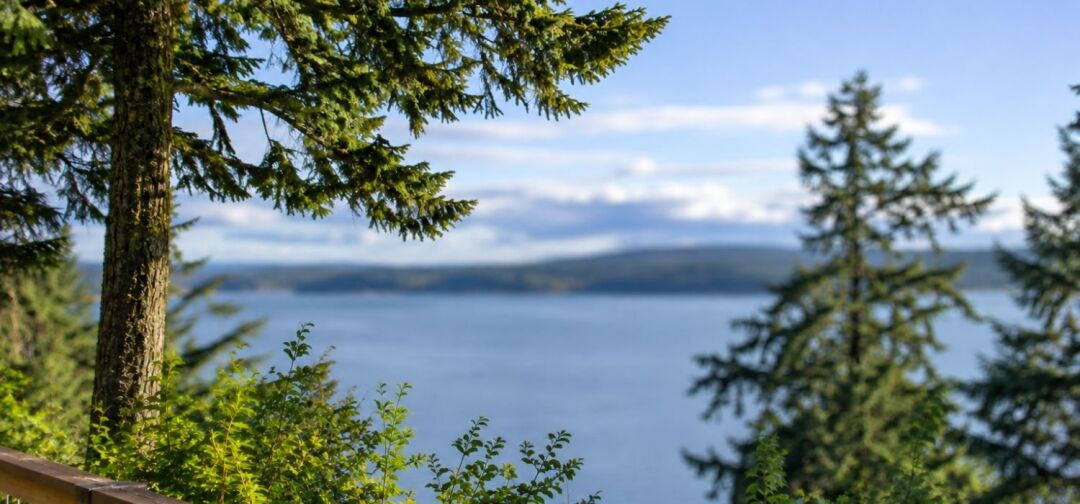
You bought the place for the water view. Ten or 15 years later, the firs and maples along the bluff have filled in, and now you’re catching glimpses of Hood Canal between branches instead of the whole sweep of it. The good news? You usually don’t have to choose between your trees and your view.
Good view trimming in Belfair, WA, and Tahuya opens up sight lines while keeping trees healthy, stable, and good-looking. This guide covers the techniques that work, the ones that backfire, and what to know about waterfront rules before anyone picks up a saw.
Our climate grows trees fast. Douglas firs keep adding height every year, bigleaf maples spread wide canopies, and red alder shoots up quickly along shorelines and cleared edges. A view that was wide open when the house went up can close in within a decade.
Waterfront trees also tend to sit right between the house and the water, often on a slope below the deck, where even modest growth can block most of the view.
Good view tree trimming relies on a handful of standard pruning methods, often combined on the same tree. Each one opens the view differently.
Tree thinning for views removes select branches from within the canopy, allowing you to see through the tree rather than around it. The goal is an even, natural-looking openness, a bit like looking through a screen rather than a solid wall.
Proper thinning takes smaller branches spread throughout the crown. Overdo it, and you end up with bare inner limbs and tufts of foliage only at the tips, which arborists call lion-tailing. Those limbs get heavy at the ends and weaker in the wind.
Crown raising removes lower limbs so you can see underneath the canopy. On conifers, people sometimes call this “skirting up.” It works well when the view sits below the main body of the tree, like the water line from an upper deck.
Taking too many lower limbs at once can leave a tree top-heavy, though. A common rule of thumb is to keep live branches along at least the upper two-thirds of the tree.
Crown reduction shortens the height or spread of a tree by cutting branches back to a smaller side branch that can take over. That side branch needs to be big enough to do the job, usually at least a third the diameter of the branch you’re cutting. This method works best on broadleaf trees like maples. Most conifers, including Douglas fir, don’t tolerate height reduction well, so it’s usually off the table for them.
Windowing opens a specific gap in the canopy, framing a single element of the view, such as a stretch of water or a distant peak. It’s a good choice when you only need a single sight line rather than a full panorama.
Cutting the top off a fir to see over it looks like the fastest fix. It rarely stays fixed. A topped conifer often sends up several new leaders that compete with each other at the cut. Those new tops are weakly attached and grow back into view within a few years. They’re also more likely to break in a storm, and the cut itself can allow decay to set in.
We’ll top a tree if a customer asks, but we’ll usually recommend thinning, raising, or windowing instead, since those hold up much better over time.
A common industry guideline is to remove no more than about a quarter of a tree’s live canopy in one season. Going past that stresses the tree and can trigger a flush of water sprouts, which defeats the purpose.
If a view has been closed for years, opening it over a couple of seasons is easier on the trees and yields longer-lasting results.
Waterfront tree trimming comes with a few extra considerations.
Shoreline and slope rules. Mason County regulates vegetation near shorelines and on steep slopes, and some trimming or removal in those areas may need county review or approval. Rules vary by site, so check with the county before planning major work near the water.
Slope stability. Trees and their roots help hold bluff soil in place. Removing trees on a steep bank can increase the risk of erosion or landslides, which is another reason trimming usually beats tree removal on waterfront lots.
Pacific madrone. These red-barked trees grow along many Hood Canal bluffs. They tend to react poorly to heavy pruning and soil disturbance, so they deserve a light touch.
Nesting birds. Federal law protects the active nests of most native birds. If you’ve noticed a nest in a tree on your trim list, mention it.
Sometimes the tree blocking your view isn’t yours. Start with a friendly conversation. Neighbors are often open to having trees thinned, especially if you offer to cover the cost.
Always get the owner’s written permission before anyone cuts. Washington takes unauthorized tree cutting seriously, and trimming a tree you don’t own without permission can lead to real trouble. If you’re unsure where property lines fall, sort that out first.
For most broadleaf trees, late winter through early spring works well, since dormant branches are easier to read. With conifers, just avoid heavy cuts during the hottest, driest weeks of summer.
Most trees need a touch-up every two to three years to keep a view open, and fast growers may need it sooner.
View enhancement tree trimming is one of our specialties, and it’s a highly sought-after tree service around here. It starts with figuring out what you actually want to see.
Before your estimate, try this:
Steep waterfront slopes can rule out a truck, so climbing is often the better way in on bluffs. Where there’s a flat, solid spot to park, our 55-foot bucket truck can reach a lot of the canopy. Either way, the goal is a view you can enjoy and trees that still look like trees. That’s what good aesthetic tree trimming is all about.
If your view of the canal has slowly disappeared, view trimming in Belfair, WA, and the Tahuya area can bring it back without sacrificing the trees that make your property feel like home.
We carry the licensing, insurance, and bonding you’d expect, plus membership in the Tree Care Industry Association. Your estimate is free if you’re in our service area, and you can ask about financing and our discounts for first responders, veterans, and seniors. Reach out to us, and let’s figure out how to get your view back.
Shelton WA 98584
Mon - Fri 8am- 6pm
Sat - Sun by Appointment
Call us for a free estimate
360-490-7001
