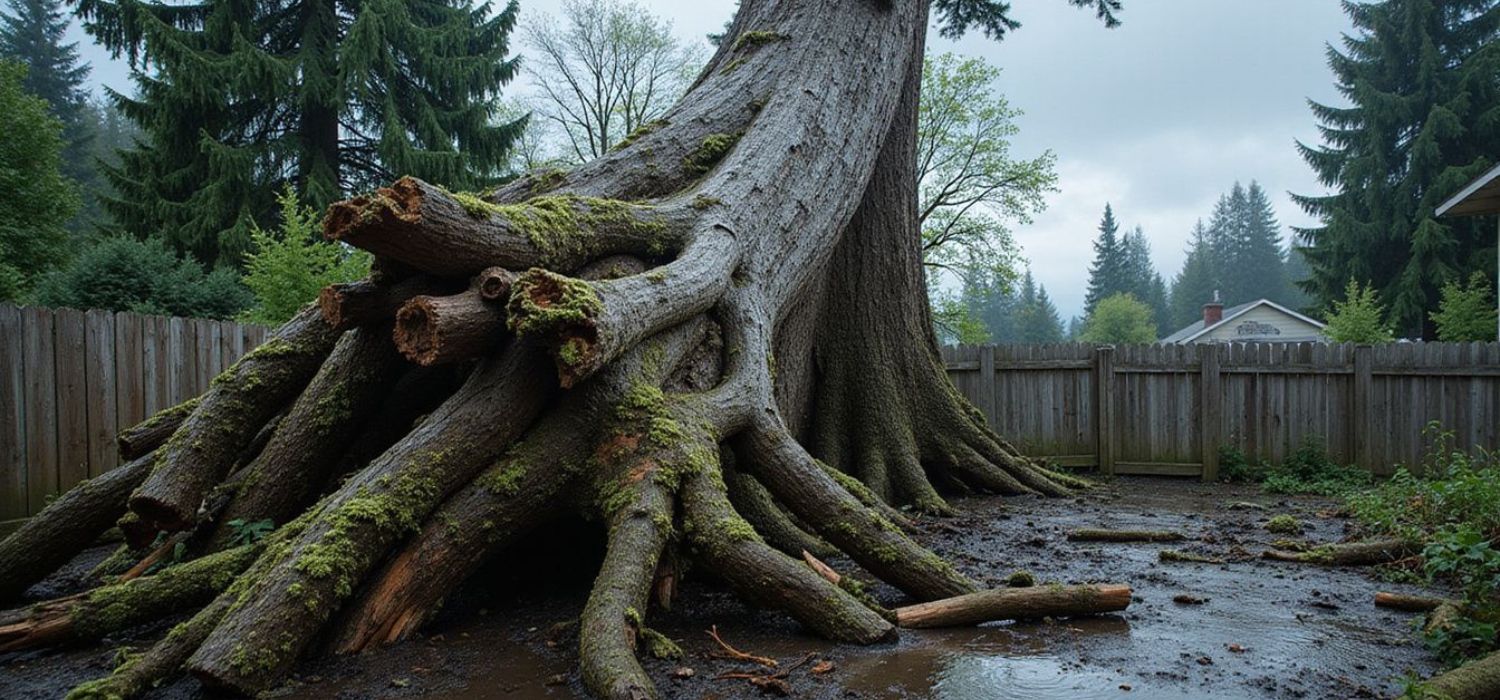
You know how one rough storm can quickly turn wind-damaged trees in Olympia, WA, into a property and neighborhood safety issue. Across Western Washington, the pattern is familiar: wet soil, gusty wind, then a sudden lean, a root plate lift, or a big limb on a roof.
We put this article together to bridge that gap between “that tree looks off” and “here are the next steps that actually reduce risk.” We’ll walk through the weather patterns that matter, what a visual tree assessment can and cannot tell you, what aerial inspections reveal, and when a certified arborist should take over with a formal tree risk assessment.
Western Washington weather is not “one forecast fits all.” The Olympic Mountains, the Puget Sound Lowlands, and the Cascades create sharp local differences in rainfall and wind exposure, even within the same county. That matters for tree care, because root strength depends on soil structure, drainage, and how long the ground stays saturated.
The National Oceanic and Atmospheric Administration’s (NOAA) 1991–2020 climate normals put mean annual precipitation around 37.1 inches in Seattle and 50.62 inches at Olympia Airport, while Olympic National Park reports 140–167 inches per year in its rain forest valleys. Those ranges help explain why the same species can behave very differently from one neighborhood to the next.
In our inspections across the Pacific Northwest, we see the same species show different weaknesses depending on exposure. Douglas fir, western red cedar, red alder, and bigleaf maple each respond differently to wind, heavy rain, and soil movement. That’s why we treat “weather” as a site condition, not background noise.
High winds and storms drive the most obvious failures: broken leaders, split stems, and sudden uprooting when the root plate can’t hold. Wind risk also jumps after recent pruning that left uneven weight, after construction disturbed roots, or after the soil has stayed saturated for weeks.
The National Weather Service generally uses High Wind Warning criteria of sustained winds of 40 mph or more for at least 1 hour, or gusts of 58 mph or more. Wind Advisory criteria are set by local forecast offices and often begin around sustained winds of 30–39 mph, with gust thresholds below warning level. Use those alert levels as a practical trigger to move from “keep an eye on it” to “inspect now.”
What we recommend before the wind arrives:
When trees and utilities mix, we treat electrocution risk as the top priority. If a limb is in contact with a line, step back and get the utility involved before any cutting starts.
Heavy rainfall and flooding change tree stability from the ground up. Even a healthy canopy can fail if oxygen-starved soil starts killing fine roots, or if water movement erodes soil away from the root collar. We see failures spike after repeated rain because the ground loses shear strength, then a wind event provides the final push.
The NOAA’s 1991–2020 normals for Olympia Airport show November averaging 8.21 inches of precipitation and about 19.5 days with measurable precipitation. That kind of month leaves little room for soils to dry down, especially in shaded yards and low spots.
Rain-driven warning signs we take seriously consist of the following:
On sloped sites, heavy rain can also raise landslide risk. If your trees sit above a steep bank, a ravine, or a shoreline bluff, treat drainage control and root preservation as part of tree protection, not separate projects.
Hazardous trees aren’t defined by species alone. A tree becomes hazardous when defects, site conditions, and targets line up in a way that makes failure unacceptable.
A formal tree risk assessment helps us move past guesswork. In practice, we evaluate the likelihood of failure, likelihood of impact, and consequence, then match mitigation to the target and the tree’s value. When we need greater clarity, we may use advanced tools to quantify internal conditions. Common examples include a Resistograph for micro-drilling resistance readings and sonic tomography for mapping internal decay, especially when a tree has major targets and unclear internal structure.
We also keep forest management in view. In many cases, selective pruning, preservation, and reforestation with site-appropriate native trees protect wildlife habitat while reducing the risk of property damage.
After storms, the biggest danger is often what you can’t see: loaded hangers, tensioned wood, and broken tops caught in other crowns. We treat every storm-damaged tree as an active worksite until proven otherwise.
Here are some safe next steps after a storm:
For removals and heavy limb handling, professional crews often rely on controlled rigging systems. That controlled approach protects structures, fences, and the surrounding landscape.
Soil is the hidden factor in many failures we respond to. If the soil can’t hold, the trunk and canopy strength won’t matter. That’s why we assess the critical root zone, drainage paths, and soil compaction before deciding on pruning, cabling, or removal.
Here’s a practical root-zone check you can do:
If you see soil heave, new lean, or fresh cracking after storms, treat it as an emergency condition and bring in a certified arborist with qualified tree risk assessors available for a formal evaluation.
Tree inspections catch defects before they become failures. They also help you avoid unnecessary removals by focusing work where it reduces real risk. For most properties, we recommend routine tree inspections on a regular schedule and an additional check after severe weather events.
What a professional inspection should deliver:
We inspect trees after storms and on a regular schedule because many hazardous trees look fine until the last moment. When you do a quick visual tree assessment, aim for clarity and consistency. Here’s a short checklist that beats a long, one-off walkaround.
Preventing property damage starts with two habits: protecting the root zone and reducing wind load in the canopy through proper pruning. For high-value trees near structures, supplemental support systems such as cabling or bracing can be appropriate, but only after a tree risk assessment confirms the structure can safely benefit from support.
Here are some tree protection practices that reduce storm risk:
Western Washington weather can turn small defects into big failures, especially when wind hits after heavy rain. We recommend regular tree inspections and quick checks after major storms, to spot hazard trees early and protect the critical root zone.
If you’re dealing with wind-damaged trees in Olympia or anywhere across Western Washington, we at Carlson Tree Care can help you choose the right next step, pruning, support, monitoring, or removal, based on a clear tree risk assessment.
Age alone doesn’t make a tree unsafe. Disease, root loss, and structural defects make a tree hazardous.
Prune dead limbs and thin crowded branches to reduce wind load. Schedule regular maintenance and get a professional tree risk assessment for large or leaning trees near structures to find hazard trees early.
Saturated soil lowers root stability. Roots slip when the ground is waterlogged so that trees can topple in storms. This increases hazards near homes, roads, and utility lines.
Strong winds and heavy rain pose the biggest threats in Western Washington State. Wet, saturated soil and rare heavy snow raise the chance of falling branches and uprooted trees.
Shelton WA 98584
Mon - Fri 8am- 6pm
Sat - Sun by Appointment
Call us for a free estimate
360-490-7001